
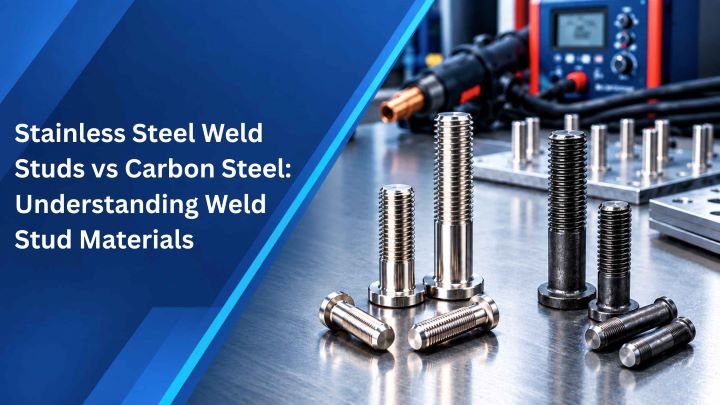
Choosing between stainless steel weld studs and carbon steel weld studs is more than a material-cost decision. The right choice depends on corrosion exposure, base-metal compatibility, required properties, welding process, and service conditions.
This guide explains the technical differences so engineers, fabricators, and purchasing teams can select the appropriate material with greater confidence.
What Are Stainless Steel Weld Studs?
Stainless steel weld studs are fasteners containing a minimum of 10.5% chromium, which forms a self-healing chromium oxide layer on the surface, according to the International Stainless Steel Forum. This passive film, only 1 to 3 nanometers thick, is what gives stainless steel its corrosion resistance.
World Stainless identifies 10.5% chromium by mass as the minimum needed to qualify as stainless steel because chromium supports the formation of the protective passive film. Nickel, molybdenum, and other alloying elements can further modify performance.
For weld studs, the specific grade matters. Complete Stud Welding lists stainless options including 302, 304, 310, 316, and 321, while its standard threaded inventory is mostly 302HQ/30430.
Carbon steel studs, by contrast, contain little to no chromium and rely entirely on paint or plating for protection. Because at least one material in the joint is stainless, this type of work falls under AWS D1.6, the Structural Welding Code, Stainless Steel, which contains a dedicated clause governing stud welding.
Stainless Steel vs Carbon Steel Weld Studs: Key Differences
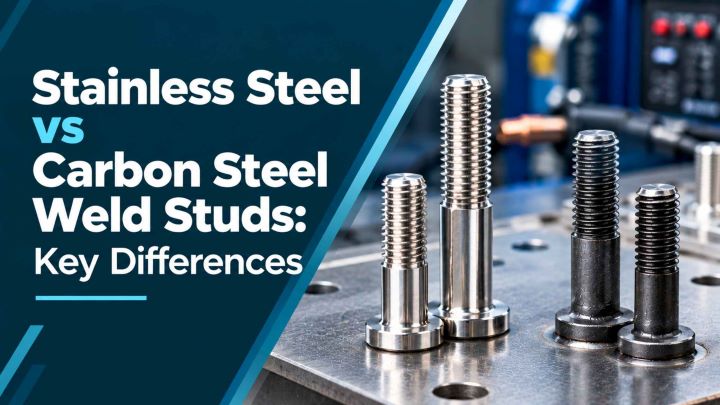
Carbon steel and stainless steel behave differently because their chemical compositions are different. Complete Stud Welding specifies low-carbon steel weld studs in ASTM A108/A29, Grade C1010 to C1020 material per AWS D1.1, while stainless grades are separately specified.
Corrosion Resistance
This is where stainless steel stud welding pulls ahead. The chromium oxide layer regenerates itself when scratched, so bare stainless studs keep performing even after surface damage.
Carbon steel studs have no such layer; once a coating is compromised, rust sets in quickly. For 316-grade studs, the added molybdenum (2-3%) further improves resistance in chloride-heavy environments like coastal structures and marine decking.
Strength and Weld Integrity
A properly executed stud weld, whether on carbon or stainless material, produces a joint stronger than the base metal itself. However, stainless requires tighter process control. AWS D1.6 limits interpass temperature to 350°F for austenitic stainless steel during welding steel studs, preventing sensitization that can lead to cracking.
Carbon steel tolerates a wider thermal window, which is one reason it welds faster in high-volume production.
Cost Considerations
Stainless steel studs cost more upfront than carbon steel. But in corrosive, washdown, or outdoor environments, that premium pays off through lower maintenance and fewer replacements over the structure’s life. For indoor, painted, or budget-driven structural work, carbon steel studs remain the practical choice.
Why Stainless Steel Weld Studs Resist Corrosion
The major advantage of weld studs stainless steel is corrosion resistance. Type 304, for example, is an austenitic stainless steel with approximately 18% chromium and 8% nickel as a typical composition.
Type 316 adds molybdenum. Nickel Institute data lists 316 at 16–18% chromium, 11–14% nickel, and 2–3% molybdenum, with a maximum carbon content of 0.08%.
That molybdenum addition is significant in chloride-containing environments. World Stainless reports that 316 provides better resistance to pitting and crevice corrosion than 304 in such conditions. Therefore, a stainless steel stud welder installation exposed to moisture, chemicals, or chloride environments may require a different stainless grade than an indoor application.
Choosing the Right Stainless Steel Weld Stud Grade
There is no single “best” stainless grade for every application.
304 is a common general-purpose austenitic grade. It combines corrosion resistance, ductility, and weldability and is widely used across industry.
316 becomes more attractive when improved resistance to chloride-related pitting and crevice corrosion is required. Its molybdenum content is the key compositional difference.
Other grades can be appropriate for elevated-temperature, stabilization, or specialized requirements. Complete Stud Welding, for example, identifies 310 and 321 among its stainless weld-stud options.
Selecting Stud Welding Equipment for Stainless Steel
The correct stud welding equipment depends on stud diameter, stud design, material, base metal, and welding process. Reliable stud welding equipment matters as much as the stud material itself.
Look for stud welding machines with adjustable weld time and current settings built specifically for stainless steel’s welding characteristics, along with technical support that understands the difference between stainless and carbon steel setups.
For smaller stainless applications, capacitor-discharge equipment can be appropriate. Complete Stud Welding’s TWE 375, for example, is specified for studs and pins from 14-gauge through 3/8-inch full-flanged stainless steel studs. Its TWE 250 is specified for 14-gauge through 1/4-inch full-flanged stainless steel studs.
For larger applications, different stud welding machines and ARC-welding configurations may be required. The equipment should therefore be selected from the actual stud and base-metal requirements, not from diameter alone.
When to Choose Carbon Steel Stud Welding Over Stainless
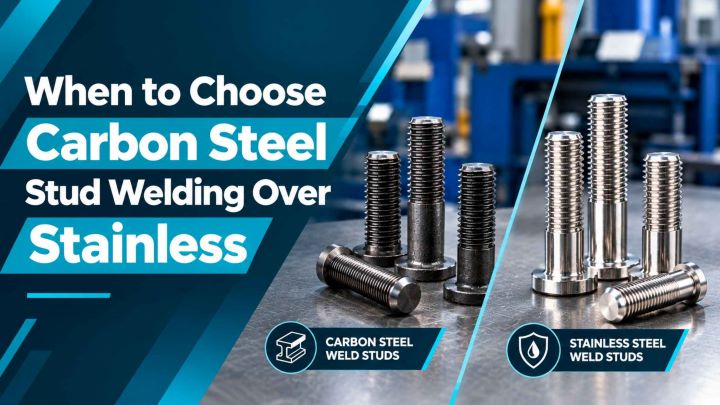
- Choose stainless for marine structures, food and beverage plants, hospitals, and any exposed, unpainted architectural application.
- Choose carbon steel for indoor structural framing, painted assemblies, and cost-sensitive projects without corrosion exposure.
Not sure which fits your project? Our process selection guide breaks down every option side by side.
Get Expert Guidance from Complete Stud Welding
Complete Stud Welding supplies weld studs, accessories, and stud welding systems for purchase and rental. Its product range includes stainless and mild-steel weld studs, along with equipment and technical support for different applications. We also provide in-shop training, troubleshooting, and repairs.
If you are comparing stud welding equipment, need help selecting welding steel studs, or are unsure which stainless grade fits your application, talk with our technical specialist.
Call us today at 216-904-4008 or request a quote to find the right stud welder and stud material for your next job.
Comments are closed.